Archive for category Music
New Music Video for “Beloved”
I was thrilled when director, Shayde Christian selected the title track off of the “Beloved” album to be placed in his feature film “Painting in the Rain“. To my further enjoyment, he made this music video for the song:
I understand that the film is in the final stages of post-production. I can hardly wait to see it.
My New Friend — Jango Internet Radio
I love listening to Jango Internet Radio – and you will too!
New Album by Bill Leyden — “Tracking the Bear”
Each time that I start a music project I wait to see if the music is going to come out as solo Native American-style flute music or whether there will be orchestration. I admit to a certain soft spot for orchestrated soundtracks, and I think I naturally lean to string arrangements with the addition of traditional woodwinds like the silver flute and the oboe.
I can’t really say that I ever start a musical project — more truly, it starts me! The last project, “Talking Stick” was like that. The recording hiatus that I had planned ended abruptly even before it started. And here it comes again – “Tracking the Bear.”
As a videographer, I find that many of the tracks are suitable for backing tracks of life stories and testimonials of trans-formation. This is music of contemplation and transformation. The musical phrases do not often repeat, but instead follow an idea to a conclusion ‘in-the-moment.’

The Sacred Wood Block Used on "Tracking the Bear"
After completing the album, I noticed that the flute phrases would appear in different tracks, slightly altered as if they were sweetened scents on the wind. Of course! I was tracking a musical scent. I hope you enjoy the result. Look for it on BandCamp and iTunes in February, 2012.
About the Flutes
On this album, I used flutes made by the following friends and craftsmen:
Returning to Joshua Tree — Again!
It is no secret that the Joshua Tree Retreat Center is a special place. I have blogged about it often. Most people that I talk to do not realize that the center is open for personal retreats. It was this magical place that inspired the album, “Return to Joshua Tree,” which remains one of the most popular of the thirty-five or so projects that I have completed.

Return to Joshua Tree Album Art
I thought I would re-post an article from the Executive Director, Victoria Jennings in which she describes her personal experiences and some of the history of the 400 acre center.

Victoria Jennings, Ex. Dir., Joshua Tree Retreat Center, CA
Victoria was gracious enough to sit down with me and re-live the article. The sound-bite below is from that interview.
The article follows:
“The moment that I stepped onto the grounds of the Joshua Tree Retreat Center, I could feel a shift. It wasn’t an earthquake, but rather, a shift in energy. It was if if the physical landscape became some kind of portal to the inner landscape of my higher mind. Coming from the hubbub of the city, the silence was so deep that it awakened me. I felt an impulse to search my soul and experience the world as it truly is, uncluttered by clamor of urban life.
As I walked the land, I was captivated. Nestled among meditation pathways and canopied by trees and flowering oleander were labyrinths, ponds, open spaces and magical hidden nooks. The surrounding mountains gave way to clear blue skies, and I had an incredible sense of wide-open space. All kinds of creatures—rabbits, squirrels, owls and other rare birds—roamed or flew about, oblivious to my presence.
It’s no wonder Edwin J. Dingle chose this magical site to establish his 420-acre spiritual center back in 1948. He’d recently returned from Tibet, and the high desert of Joshua Tree offered the kind of peace and spiritual connection to the land that he had experienced there. Equally important, it was close to his growing community in Los Angeles.
Dingle had traveled to China to become editor of the influential Straight Times of Singapore. As a fellow of the Royal Geographical Society of England, he was contacted during the Boxer Rebellion of the early 1900s to do a mapping expedition across China, producing works that would be used in WWII and beyond.
As Dingle and his mapping caravan crossed China, he fell seriously ill and nearly died. Nonetheless, he continued onto Tibet, and when he finally arrived, he as greeted at the monastery gates with a question: “What took you so long?” Somehow, they’d been expecting him.
Upon his return to the West, the seeker began sharing the teachings he had learned from the monks. The maps he’d drawn of China had made him a wealthy man, so he decided to build a spiritual retreat and share want he’d learned. “I wanted to create a sacred space where great leaders would come,” Dingle said.
In 1941, dingle was driving down a lone desert road in search of a suitable site, when he suddenly felt compelled to pull over to the side of a barren road. In that moment, a burst of light came down from the heavens. As its rays poured over the landscape, he heard a voice say, “The desert will bloom like a rose…someday there shall be cities built around the land. Great highways shall lead here as a place of respite.” Dingle soon brought this vision to reality—building began on the site in 1948.
From its beginnings, this land has been an energy vortex immersed in a protective aura. Ding Le Mei, as Dingle became known, taught a mixture of meditation, pranayama (breath work), affirmations and other spiritual practices that lead to balance of body, mind and spirit. His philosophy of MentalPhysics is based on the way the mind creates the physical world and it would eventually make its way to over 220,000 students worldwide.
The great leaders Ding Le Mei had envisioned came to him as well. Yogananda walked the grounds in earlier times. Shirley MacLaine was here at the beginning of her spiritual quest. JZ Knight (Ramtha) held retreats here before building her facility in Oregon. The founder of Astara was a student of MentalPhysics. And that’s just the beginning. Jack Kornfield has been leading groups here for 25 years, Alberto Villoldo for more than 10. Many more have been drawn to this sacred land, including Byron Katie, Jean Houston, Ram Dass, Lama Surya Das, Stanislav Grof, Joe Dispenza, Dan Millman, Swamiji Vethathiri Maharishi, Lynn Andrews, Ken Page, Stephen Levine, Terry Cole-Whittaker, Moshe Feldenkrais, Joseph Heller, Gabrielle Roth, Kalu Rinpoche, Lama Yeshe, Geshe Gyeltsen, Zong Rinpoche, Swami Vishwananda, and Sun Bear. Hundreds of thousands from around the world have embarked on journeys of power and mystery to absorb the wisdom of these great teachers, as well as that of the ancient rocks and trees.
The property has changed substantially since Dingle was first guided here. For starters, there are several beautiful buildings reminiscent of Frank Lloyd Wright’s Taliesin. Dingle had a relationship with Wright, albeit a rocky one. Perhaps their biggest obstacle was philosophical perspective.
For Dingle, the layout of the buildings on leylines (lines of energy within the earth) furthered a connection to the land and the Buddhist designs he admired. But the Vastu (a building philosophy similar to Feng Shui) Dingle had learned was foreign to the architect at that time. Wright ultimately passed the job on to his son, Lloyd Wright, a less-recognized master in his own right.
The synergy of their efforts is one of the first things that impressed me. The roof of one dining hall actually emerges from the ground, sloping up from the landscape to a 70-foot crescendo. With concrete roofs, embedded stone from the land’s own rock quarry and walls of glass, the design embraces both ancient Tibet and 20th Century Art Nouveau.
There is something quite special in the vastness of the high desert—the dichotomy of the landscape and the explosion of color. Deep purples and bright oranges appear in stark contrast to the languishing blues in the sky.
The nights are filled with so many stars that sometimes I think I must be in another dimension—a direct connection with the Divine. The air is clear, delicate and unpolluted and the energy is strong, with 16 vortexes to delight ones spirit. The land is filled with such peace that it immediately calms and centers me each time I return. Some of the magic of the land may be attributed to the fact that it lies on an aquifer (an underground river), discharging an intriguing magnetic effect on those who enter this ancient landscape. I can’t help but wonder if Ding Le Mei somehow knew of the abundant underground water, or of the fault lines on either end of the property that allow the land between them to lie still when the surrounding area shakes with earthquake tremors.
People from all over the world have returned to this well-known energy vortex just to scribe their circle in the sand or recharge their personal stones. The grounds’ Healing Pond, filled by its own well, is a replica of the Chalice Well in England. Healing stones and crystals from all over the world are buried in sacred patterns beneath its base.
Whatever the explanation, Joshua Tree Retreat Center has grown to become the oldest and largest spiritual retreat center in the western United States, a non-profit organization whose mission is to nurture and support the infinite human potential. We’d be honored to share the magic of this land with you.”
Architect Lloyd Wright, son of Frank Lloyd Wright, who continued the work of his father here, had this to say:
“In the mountains of California, above the Mojave lies a plateau overlooking the desert, sloping to the East,facing the morning sun, into the West where San Gorgonio’s snow-capped peak reflects the glow of the setting sun. Here, The Ding Lei Mei Institute is located. Moved by a sense of the tranquil nobility and eternal beauty of the desert, I have planned, not a city of asphalt, paving and steel, or the tight mechanical grid and congested living barracks but a city of the Desert, spacious, free-sweeping; its broad floor carpeted by myriads of desert blossoms; its residents dwelling at peace, and sharing with the soil, sky and trees, their joy of living, its centuries-old Joshua trees standing like sentinels above its homes.”
“What Do You Mean, Mumbo-Jumbo?” (Remembering Conrad Birdie and Energy Healers)
After a recent sojourn into the Mojave Desert to capture stories of healers, I guess that I was still overwhelmed even several weeks later by some of the testimonials. A typical snippet of what I had come back with would be Dianne’s story:
After showing my son, Damon some of these, he mused about doing a testimonial himself about some of his life experiences. Although he has a wealth of such experiences, there was no doubt in my mind that his stint in front of the camera was going to be something between tongue-and-check and irreverent. This presumably would be meant to confound all attempts by me to get to a deep level during an interview.
Knowing that he, like most photographers that I know would prefer to stay on the other side of the camera, I attempted to encourage him by adorning him with my favorite sets of Love beads and filling his hands with a sacred musical wood block, complete with mallet that I had retrieved years ago from the Yucatan.
“Camera is rolling, sound is speeding, and … ACTION!”
(Pause and silence).
Damon: “I don’t know … I’m not feelin’ it!”
Boy, have I heard that before! It has become my current obsession to figure out how to get someone in front of the camera beyond that spot and to dig deeply into those feelings to bring out something real. I try to remember the times spent with directors Rod Menzies and Shayde Christian to see if I can remember how they did it. I am not sure exactly what to do in every situation, but I instinctively feel that the performance in front of the camera springs from that twilight area very close to our fears and passions, like some artistic serpent coiled and ready to strike forth. As the photographers delving into video, we attempt to invite the serpent to strike, without invoking its ire.
As Damon continued to silently express his feelings, I saw in the camera moments of supreme facial realities that would rival any actor. These moments confirmed my feelings about that twilight area from which art springs from the deep subconscious. But the words, probably immovably blocked in some cerebral lobe would have to wait for another day to amaze me.
Finally, I couldn’t take it any more. Overcoming my own fear of being in front of the camera, I burst, “let me give it a try!” I took up the ceremonial musical wood block, left him standing there in the forest with the Love beads, and gave it a try.
Not to bore the reader with my impromptu script, I will suffice it to say that my sister, upon seeing the performance wrote, “what a bunch of [explicative deleted] mumbo-jumbo!”
“You’ve gotta be sincere?”
I don’t know, I thought it was pretty sincere, if not in a mumbo-jumbo sort of way.
Maybe this whole story is just an excuse to pay homage to the late performer, Jesse Pearson, who created one of my favorite characters, the man with the gold lamé jumpsuit, Conrad Birdie. Maybe I need look no farther than his performance for the answers I seek: “You’ve gotta be sincere — honestly sincere!”
Reflections of Q’ero Elder, Don Francisco
“You look like a strong guy, Bill. Would you mind taking Don Francisco’s despacho* materials over to his room? It’s just across the parking lot.” Before answering, I said to myself, ‘how hard could it be?’ “Sure!”
The nice lady parted a set of draperies and there were three large Rubbermaid storage containers with contents I would guess weighing about 100 lb. I set about my task, staging the containers through the parking lot individually and finally I stacked them in front of Room 104 somewhere in Park City, UT. Before knocking on the door of the Q’ero elder, whom many revere as the penultimate example of the spirituality of the lost world of the Inca, I thought that I heard some small sound from within. I knocked … quiet. I knocked again … silence.

Don Francisco of the Q'ero
Not to be deterred, and positive that my instincts were correct, I knocked loudly a fourth time. That did the trick! There was the soft rustling of clothing and I thought that I heard a water spigot close. Then, a faint brush at the door. “¿Quién es…? [Who is it?]” I thought to myself, ‘how should address this elder? With deference? Perhaps some sort of greeting in his native language of Quechua?’ Then I remembered the words of advice given to students and supplicants throughout time and space: “Be yourself!” So I answered, “¡Es la Policia! [It’s the Police!]”
The door knob turned slowly, and the door cracked ever so slightly. There was one brown eyeball staring intently … seriously through the crack in the door up at me. A moment of recognition on his part and the door flew open with a force that surprised me. And there he was, standing in most of his formal regalia including the multicolored ceremonial poncho coming toward me with outstretch arms. An embrace. “¡Ah, Policia! ¡Policia International! ¡Gracias, muchas gracias!”
Seven years later, Don Francisco still calls me “Policia.”
A couple of years later, Don Francisco gave a group of us The Creator Rites. It was immediately after the rites that I went home and found a place to begin recording the Native American-style flute. The musical journey continues to this day and is a constant source of healing and awe.
I saw Don Francisco this weekend last, and made the above image of him at a fire ceremony. I can’t help smiling when I see him.
* the despacho is a major ceremony of the Q’ero, during which the prayers and intentions of a person are placed symbolically in a mandala of materials that are subsequently burned or buried for the purpose of achieving ‘right-relationships’ in one’s life.
Visiting Wolfs Robe in His Sedona Flute-Making Workshop
Crafting the Native American Flute
“Hey, I’m thinking of offering a DVD to the people who purchase my “Grandfather” flutes. Can you help me?”
Wolf knows that I can’t say no to him, so I dutifully went over to Sedona one morning to make some images of him in his workshop.

Wolf fashions the "effigy" for a cedar "grandfather" Native American flute
I am surprised by the amount of work that goes in to the making of one of these. The flutes are measured, cut, halfed, bored, fit with a ‘block,’ glued, shaped, carved, drilled, sanded and finished.
As most every Native American flute player has learned and appreciated, the results of the flute-making process transcend the physical appearance and feel of the flute. Known by many names in the lore, including the ‘love flute’ and the ‘courting flute’ etc., the Native American flute is somehow able to communicate the players’ feelings in the moment — the spectrum of human feelings. In addition, they can bring the sounds reminiscent of nature to life. It is not uncommon to hear a skilled player mimic bird and animal calls.
An Old Trick
For decades, I have been trying to control what would cause my sisters to call me “Bad Billy.” I don’t think that I have made much progress yet, although sometimes — just sometimes I feel that I may have. But it may only be just a feeling.
Wolf wanted to show one of the final steps in the flute-making process: blowing off the saw dust after sanding and just prior to applying the clear coat. He thought it would be neat to blow the dust toward the camera. (Obviously Wolf is not accustomed to purchasing Canon “L-Series” lenses). As he lined-up the flute with the lens and prepared to blow a dust cloud into the equipment, I turned the tables on him; I surreptitiously grabbed his compressed air hose and let him have it.

Wolfs Robe Falls for a Cheap Trick
As my late father used to instruct me: “The old jokes are the best … that’s why they are old!”
The Magic of Stephen DeRuby’s Flutes
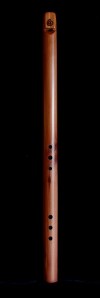
The EZ Anasazi Flute by Stephen DeRuby in A
A Flute Journey Begins
“…. We are going on a journey into your deep subconscious … to help us get there, we are going to use a map. It’s your map! But, remember: ‘the map is not the territory!’ It is a representation that we will use as a guide. After all, a map of the moon is not the moon itself!”
Continuing for another 30 minutes, medical anthropologist, Dr. Alberto Villodo guided the meditation using the concept of different rooms in a mysterious world that could unlock the unknown parts of our lives. Toward the end of the guided meditation he said, “The last room is the ‘Room of Gifts.’ Look around. Notice if there is anything there for you. There may be a gift for you to help you integrate what you have learned on this journey into your every day life. Don’t try. Just wait. Whatever is there or not is O.K. ”
That, which for me at the time was an unusual way to spend 30 minutes seems like a lifetime ago. Maybe two lifetimes! I remember looking around in my mind’s eye and saw a lone flute on the ground. I picked it up and brought it back with me, not knowing that my life would be changed in ways I could not have foreseen.
A year later, Dr. Villoldo was introducing Don Francisco, an elder of the Q’ero Nation of Peru (the descendents of the Inca) to the audience. Translating from the ancient Quechua language, Dr. Villoldo told us that Don Francisco had flown on the ‘Iron Bird’ to be with the brothers and sisters to the north – to bring the rites of passage, including the 9th rite: the Creator Rites, which had heretofore never been give by a man to another. These were the rites only given by the mountains of the High Andes to the Q’ero of Peru.
The ceremony is brief. It includes Quechuan blessings, invocations and well-wishes, and concludes with a ritual transfer of the rites from Don Francisco’s breath and medicine bundle.
As participants, we were warned (after a fashion) that things might change in our lives and that it was best to be prepared for anything. For me, this began a period of years of recording with the Native American-style flute that continues to this day. I like to tell myself that these recordings are part of my own life’s healing or part of an aural diary, as it were. But it seems much more than that. The flute has taken me on a path far-removed from the chemical engineering career that I survived onto a new path filled with people – a path of faces and feelings – a path of witnessing people’s lives at different points to-and-from their zenith. These days, instead of picking up the phone to see what the boundary conditions are at a unit in a refinery, I am more likely to speak to a healer, patient, musician or craftsman.
The Flute Makers
The first craftsman I met on this journey was Stephen DeRuby. I was looking for flute lessons and called a man named Golaná. He put me in touch with Stephen. “I use Stephen’s flutes almost exclusively,” he said. “My students use them because of the fact that they are of great quality and are perfectly tuned. Give him a call.”
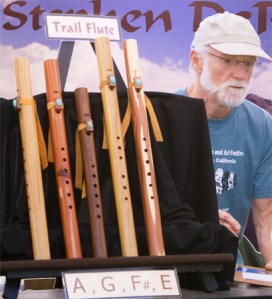
Stephen DeRuby
My admiration for these artisans of wood is not complete without mentioning John Stillwell, J.P. Gomez and Geoffrey Ellis. But I will return to them at a later time in other posts.
Stephen and I met in Northern California in 2006. I probably came away from that meeting with several flutes. I saw him over a period of three days or so, and each time he would bring something special out of an unmarked box – a one-off flute in an experimental wood or some other one-of-a kind flute. It was hard to pick a favorite, but if I had to from that trip I would say that it was the EZ-Shakuhachi flute with a C diatonic scale. He called it “the Deep Blue ‘C’.” Anyway, it began my love affair with the special fipple that made a magical, breathy sound similar to rim-blown Japanese shakuhachis.
Over the next several years, established Native American-style flute players seemed to be searching for something to distinguish themselves in the marketplace. There was an explosion of rim-blown, exotic-scaled entries into the market. The established players are talented with well-developed embouchures (mouth muscles used for playing a wind instrument), and could easily master the rim-blown instruments. A new-comer like me, on the other hand would be at least a year away from even making a sound on these. But the tones that can be achieved are well worth the effort.
Stephen DeRuby changed all of that. His unique fipple design put the sounds of rim-blown flutes within my grasp, although I hesitated a couple of years before taking the plunge. It was actually my friend, adopted brother and fellow flautist, Wolfs Robe put me over-the-top. He showed up one day with one of Stephen’s EZ-Anasazi flutes. When he played it, I couldn’t believe the sound; I had to have one.
When it arrived in its fleece case, I knew that I was in for a treat. I postponed a trip to LA to take the time to see how it would record. I have attached a couple of tracks that will explain why I postponed the trip. My first recording was called “Face the Fire,” which is the track at the beginning of this piece.
As I got more familiar with the lovely instrument, I became more adventuresome by adding some close harmonies and trills. The result was more that I could have hoped for and can be heard below:
“Talking Stick,” © 2011 by Bill Leyden. All rights reserved.Now Stephen has introduced the Kiva flute. I can’t wait to take another plunge!
On Friends and Flutes (The Story of “Leaving Sedona” on the “Coconino” Album)
Here is the song, “Leaving Sedona” on the “Coconino Album” to listen to as you read, with special thanks to Stephen Deruby for his generosity and for being a mentor. I am playing the Deep Mystic Flute on both ends of the song; Stephen is playing the Mystic Drone flute in the middle.
At the time of this writing (2011), I attended my first Native American flute festival about six years ago in Northern California. I was asked often, “who’s flute do you play?” I would answer in near-truth, “I don’t, I just like flute players.” I think I was intimidated by so many natural musicians gathered in one place that did not necessarily play the guitar (an instrument on which I can make or fake any pop sound). So in my mind it was better to suggest that I did not play rather than subject a potential listener to the squeaks that I could muster.
One of the first people that I met was master-craftsman and musician, Stephen Deruby — a man who I still call friend and delight in conversing with from time-to-time. I imposed upon Stephen several years ago and asked him to listen to a song that I was working on in which I was using one of his flutes – a “Deep Blue C Mystic,” flute. Before he gave me his sage advice, he admonished me that “friends do not send friends 192Kb/sec mp3’s in the email to review – try something a little smaller.” But then he gave his advice, but so much more: he sent the file back with a track that he added in which he played his “Mystic Drone Flute.” in accompaniment. It was (and is) gorgeous.
Stephen graciously agreed to let me publish the track with his accompaniment in the song – and of course I purchased the flute. The song became “Leaving Sedona” on the “Coconino” Album.

“Coconino” Album Art
Many people claim that area surrounding Sedona, AZ has certain energetic qualities. Everyone is different – I don’t feel anything particularly strange when I enter Sedona, but I always feel like I am passing through some transparent barrier when I am leaving — a barrier that separates Sedona from the rest of the planet. At times I feel a sense of relief that I am returning to what is familiar to me, and sometimes I feel at-once a longing to return to Sedona again. This probably sounds like mumbo-jumbo, but nonetheless I can’t deny that visiting Sedona is a singular experience.
“Talking Stick” Album by Bill Leyden Released August, 2011

"Talking Stick" Album Art
About the flutes that I used:
Lately I have been drawn to flutes in keys below middle E.
Here is the track list with the flutes that I used:
1. Talking Stick – Anasazi flute in A by Stephen Deruby
2. Flume – Low Bb Bamboo flute by NZT Designs
3. Auriga – Jeff Ball Signature flute in Eb by Geoffrey Ellis
4. Perseids – Low Bb Bamboo flute by NZT Designs
5. Pondering Winter – Low G Redwood flute by Geoffrey Ellis
6. Iron Horses – Low A Sassafras flute by Leonard McGann
7. Camarilla – Anasazi flute in A by Stephen Deruby
8. Call to Kiva – Tigerwood flute in D by Geofrey Ellis
9. Astral Muse – Flame maple flute in Em by John Stillwell
10. Lone Wolf – Babinga flute in F# by John Stillwell
11. Fire Ceremony – Maple flute in C by Geoffrey Ellis
12. Eventide – swamp ash flute in low B by Geoffrey Ellis
13. Yellowthroat – peruvian walnut flute in E by Geoffrey
14. Rejoinder – Anasazi flute in A by Stephen Deruby
15. Entreaty – swamp ash flute in low B by Geoffrey Ellis
16. Accord – swamp ash flute in low B by Geoffrey Ellis
17. Closing -swamp ash flute in low B by Geoffrey Ellis
-
You are currently browsing the archives for the Music category.
Popular Releases

Top Posts & Pages


 Bill Leyden